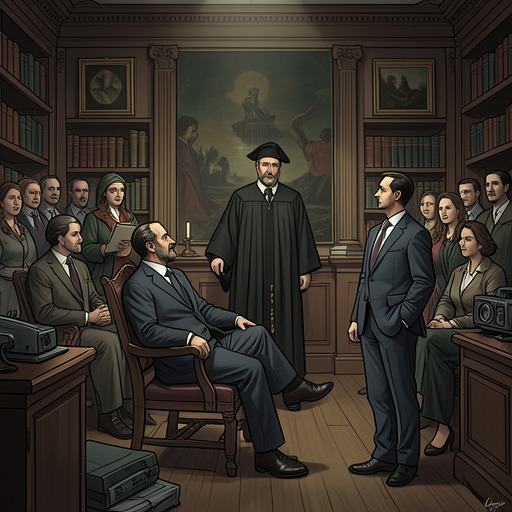
Jay C. Flowers
The Minds of Billy MilliganJay C. Flowers is the judge whose rulings shaped two decisive parts of William Stanley Milligan’s case: the legal inquiry into whether Milligan could assist in his defense and the later determination of criminal responsibility for the charged offenses. The record presents Flowers not as a diagnosing clinician but as the judicial decision-maker navigating competing psychiatric assessments, procedural protections, and distinct legal questions.
Judicial Role and the Competency Question
On January 19, 1978, Gary Schweickart and Judy Stevenson presented Flowers with a psychological report arguing that Milligan could not assist in his own defense. The evaluation had been conducted by clinical psychologist Dr. Willis C. Driscoll, who tested Milligan on January 8 and 13. Driscoll reported an IQ score of 68, while cautioning that depression had lowered it, and diagnosed acute schizophrenia. His account described a profound disruption of identity, difficulty distinguishing self from environment, and voices that Milligan believed came from people who had come from hell to torment him. Driscoll concluded that Milligan could not adequately understand events or counsel his attorneys and recommended hospitalization for further examination and possible treatment.
Flowers responded by ordering the Southwest Community Mental Health Center in Columbus to assign its forensic psychiatry unit to examine Milligan. The order opened a new assessment while raising a problem for the defense: the center was usually aligned with the prosecution. Schweickart therefore insisted that statements Milligan made during the examination be protected from use against him. When prosecutor Terry Sherman and Bernard Zalig Yavitch objected, the public defenders threatened to tell Milligan not to participate; Flowers came close to holding them in contempt. The dispute ended in a compromise: prosecutors could question Milligan about incriminating statements to the court-appointed evaluators only if he took the stand in his own defense. The defense accepted those terms and allowed the examination to proceed.
The Competency Evaluation
A later assessment brought the question directly to Flowers. In a letter dated March 13, 1978, George Harding Jr. concluded that Milligan was not competent to stand trial because he could not cooperate with his attorney. Harding also said Milligan lacked the emotional integration needed to testify, confront witnesses, and maintain an effective psychological presence in court. The letter framed competency in practical courtroom terms: not merely whether Milligan could be physically present, but whether he could participate meaningfully in his defense.
The legal record distinguishes that present-tense question from the issue eventually decided at trial. Competency concerned Milligan’s ability to understand and take part in proceedings; criminal responsibility concerned his mental state when the charged acts occurred. The evidence supplied here establishes Flowers’s order for an examination and his receipt of Harding’s conclusion, but does not specify a separate ruling by Flowers on competency. That distinction matters: a clinical diagnosis, a finding about present capacity, and a verdict about responsibility for past conduct are not the same determination.
Trial Rulings and Verdict
At trial, the defense disputed the women’s accounts through Adalana’s version of events, asserting that the three women had cooperated, had not been injured, and had received some of the money back. Judy Stevenson challenged that account. The disagreement placed conflicting narratives before the court, but Flowers’s rulings did not collapse the factual and medical issues into one.
Flowers dismissed the first rape count because it lacked corroborating evidence and did not share a similar modus operandi with the other offenses. He then considered counts two through ten under the insanity defense. The medical evidence had been stipulated, and the doctors testified that Milligan was mentally ill at the time of the offenses, could not distinguish right from wrong, and lacked the ability to refrain from the acts. With no evidence to the contrary, Flowers found Milligan not guilty by reason of insanity on counts two through ten. The two parts of the disposition rested on different grounds: insufficient corroboration for the first count, and stipulated evidence of mental illness and impaired responsibility for the remaining counts.
Significance and Limits of His Role
Flowers’s significance lies in the boundaries his decisions maintained. He ordered an adversarially sensitive forensic examination while allowing a negotiated protection for statements made during it; later, the record shows a psychiatrist addressing competency to him in explicitly functional terms. At trial, Flowers separately assessed the evidentiary basis for one count and the stipulated medical evidence relevant to the others. The resulting verdict did not itself amount to a psychiatric diagnosis or an account of later treatment arrangements. Rather, his documented role was to apply the legal questions before the court to the evidence presented, without treating diagnosis, present ability to stand trial, and responsibility at the time of the offenses as interchangeable.